s e j n b o h e m i ae r o s a
S i t e B o d y E x p l o r a t i o n
Kokorin Landscape - The Czech Republic
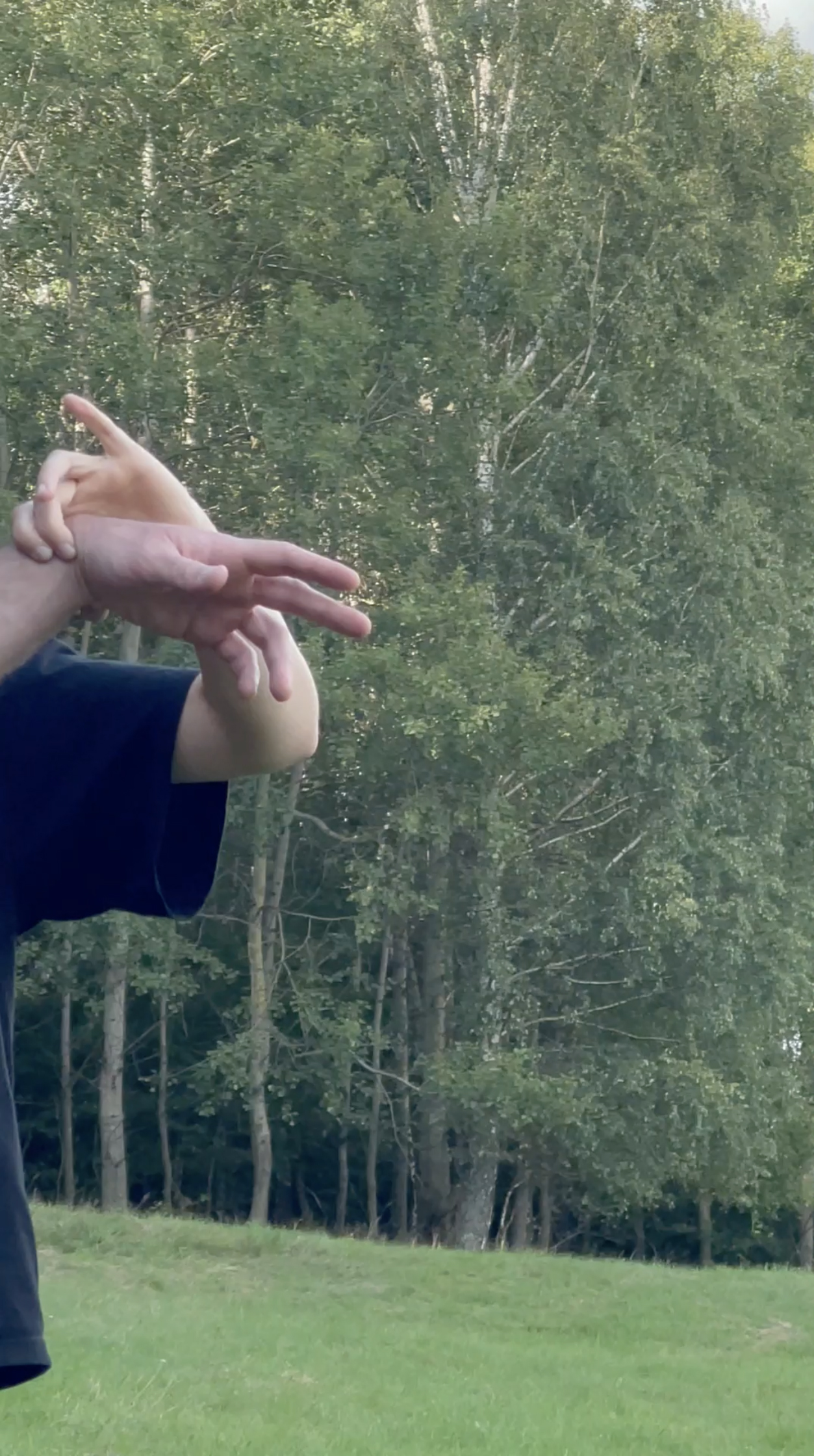
International Interdisciplinary Open-Air Workshop for dancers and artists exploring the relation among body, art and landscape
led by Frank van de Ven & Milos Sejn
Since 1995 Milos Sejn and Frank van de Ven have co-operated in their bi-annual interdisciplinary open-air Body-Site-Exploration projects in various National & Cultural Reserves in the Czech Republic (Kokorin Valley, Plasy Monastery, Bohemian Karst, Bechyne Monastery with the Luznice River, Bohemian Paradise, Sumava and Krkonose Mountains, Kuks Spa) known as the Bohemiae Rosa Project.
After thirty years, we return once again to the landscape of the Kokorin Valley and its rock formations. It is a place with a profoundly deep cultural and historical legacy — a landscape shaped by figurative sandstone rocks, caves, valleys, winding brooks, forests, groves, meadows, and the evocative ruins of medieval castles.
Our point of departure, Bohemia FARMSTUDIO in Vysoka, which lies at the very heart of this territory, offers almost inexhaustible possibilities for contemporary artistic exploration, particularly in the field of contemporary (performing) arts. Rooted in the landscape itself, the site naturally invites interdisciplinary artistic practices, dialogue between nature and culture, and new forms of embodied, site-specific expression.
The program will include:
• MB -(mind/body, muscles/bones) dance training
• practice of and reflection on physical and mental training
• walking and wandering, silent walk, pilgrimage and nocturnal journeys
• various modes of experiencing body, movement and landscape
• investigating divergent senses of space and time
• peripatetic records, drawing, writing, immediate contact with surroundings
• mental topography of a location, myth, archaic mind and genius loci
• geology, archaeology and history of the Bohemian Paradise as a model of self: layers, vertical connections and labyrinths
An integral part of the workshop will be the individual artistic projects that participants are encouraged to formulate and work on for about 1 to 2 hours a day. (in the fields architecture, landscape art, dance, performance, photography, sculpture, theatre, visual arts, biology and natural history). The workshop leaders are available to guide and support these processes.
The body is a landscape in itself moving within the larger frame of the given surrounding environment. The vertical and horizontal layering of the (historical) landscape invites us to reflect upon our own layers and connections of self and imagination.
Participants profile: for artists and advanced students working in the fields of performance, dance, landscape art, sculpture, photography, architecture, theatre, visual arts, biology and natural history.
4
-
9 August 2026, arrival evening of 3 August 2026
Meeting
Place:
Bohemia
FARMSTUDIO,
Vysoká 26, 277 24 Vysoká, Czech Republic
GPS N 50°24.68267',
E 14°32.30760'
The number of participants is limited. We recommend early applications.
Bring sleeping bag, sheets, work/yoga mat, backpack for day hikes, raincoat and hiking boots.
All participants must have a personal insurance and must provide a copy of this before start of the project.
For artists and advanced students working in the fields of performance, dance, landscape art, sculpture, photography, architecture, theatre, visual arts, biology and natural history.
No
previous (dance) training is necessary but the workshop will be physically and
mentally
demanding,
therefore
a good overall condition is required.
APPLICATION
To apply send name, a short c.v. and a motivation letter to
Frank van de Ven
frank.bwa@xs4all.nl
or
Katerina Bilejová
Katerina.Bilejova@fhs.cuni.cz
flyer
From
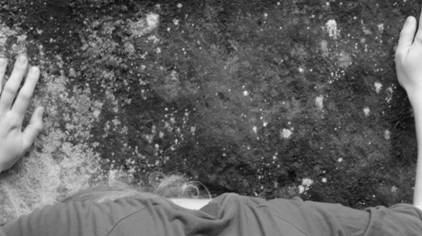
Bohemiae Rosa Project – September 11
E X T E N D E D I N F O R M A T I O N
Kokorin Valley
The Kokorin (Kokorinsko Protected Landscape Area)
The Kokořínsko – Mácha’s Region Protected Landscape Area (PLA Kokořínsko – Mácha’s Region), originally designated simply as the Kokořínsko Protected Landscape Area, is a protected landscape area in the Czech Republic. The administrative headquarters of the PLA is located in the town of Mělník. The total area of the PLA is 410 km², with elevations ranging from 174 to 614 metres above sea level; the highest point is Mount Vlhošť.
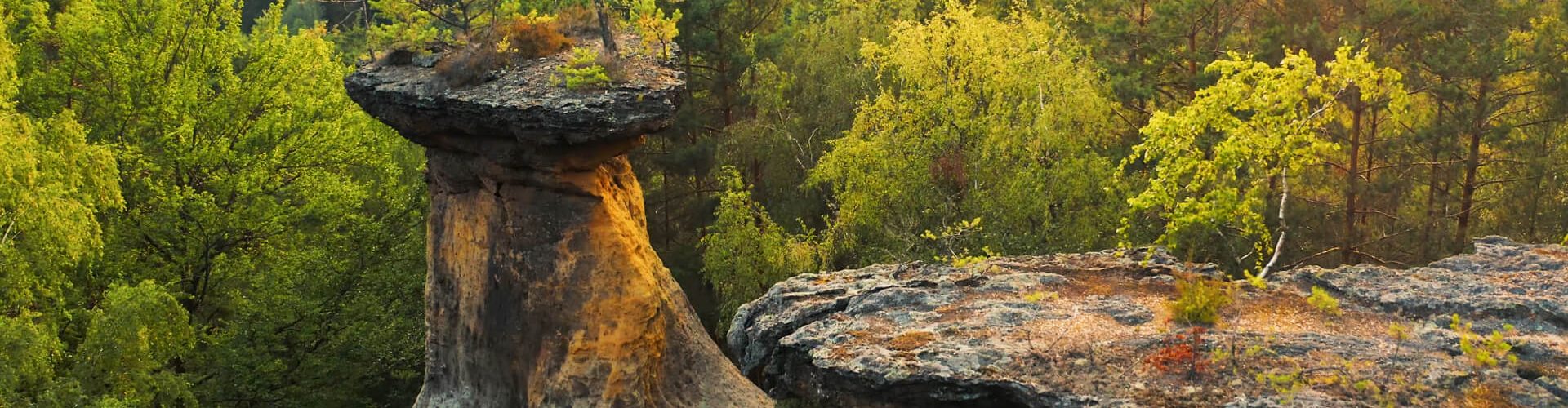
The protected landscape area lies predominantly within the Liberec and Central Bohemian regions, with only a small southwestern part extending into the Ústí nad Labem Region (Litoměřice District). The landscape has a canyon-like character; in its northern part it transitions into a hilly terrain. It is typified by sandstone rock formations, many of which form distinctive shapes such as rock overhangs, small caves, niches, and ledges. The Polomené Mountains, similarly to the České středohoří (Central Bohemian Uplands), originated at the end of the Tertiary period, when the relief was fractured and basaltic and phonolitic magma penetrated to the Earth’s surface.
Territorial delimitation
The main gateways to the Kokořínsko – Mácha’s Region PLA are the towns of Dubá and Doksy, located between the two parts of the protected landscape area. Other access points include Mšeno, situated on its southeastern edge, and Liběchov, located southwest of the PLA near the town of Mělník.
As regards the older part of the PLA (Kokořínsko), its most visited area is the southern section, encompassing the canyon-like valley and drainage basin of the Pšovka stream. The most valuable parts of this area, including side gorges and certain rock complexes and ridges around Kokořín and west and north of Mšeno, are specially protected as the Kokořínský důl Nature Reserve. The axis of the southwestern part of the PLA is the Liběchovka stream, along whose valley the I/9 road runs for most of its length; tourist starting points here include, for example, Želízy, Tupadly, Chudolazy, and Medonosy. In the area between the valleys of the Liběchovka and the Pšovka there are several “důl” valleys (canyon-like valleys surrounded by blocks of sandstone rock), such as Zimořský důl, Truskavenský důl, Šemanovický důl, Sitenský důl, Vidimský důl, Hluboký důl, Střezivojický důl, and others. In the eastern part of the PLA, the most prominent landmarks include Houska (near the sources of the Pšovka) and Vrátenská hora; closer to Dubá are Vysoký vrch and Korecký vrch. A spur of the PLA extends northwest of Dubá almost to the boundary of the České středohoří PLA. In this part of Kokořínsko, the most remote dominant features include Ronov and Vlhošť, Stříbrný vrch, and Husa; closer to Dubá are the Kostelecké pine forests, Martinské stěny, and Čap, while west of Dubá lies Dubová hora. This part of the protected landscape area also has the status of a Site of European Importance, registered under the name Roverské skály.
As for the newer part of the protected area (Mácha’s Region), the surroundings of Lake Mácha are undoubtedly among the main tourist destinations, used primarily for recreational purposes. Equally popular is the ruin of Bezděz Castle on the hill of the same name, which at 606 metres—second only to Vlhošť (614 m)—is the second highest peak of the entire PLA and, together with its smaller “twin” Malý Bezděz, forms a striking and unmistakable landscape landmark visible, under suitable conditions, from large parts of Bohemia. The peaks of Bezděz and Malý Bezděz are also protected as a National Nature Reserve. Other noteworthy sites include the Hradčany Walls in the central part of the area—an extensive uninhabited territory dominated by sandstone cliffs and gorges. Worth visiting as well are the Provodínské kameny Natural Monument with its highest peak, Spící panna (419 m), and the ruins of Jestřebí Castle. The PLA also includes the highly significant ornithological site of Novozámecký Pond.
Numerous attractive places are located in the immediate surroundings of the PLA as well: the ruins of Helfenburk, Chudý hrádek, and Starý Berštejn castles; the picturesque Peklo canyon near Česká Lípa; the Čertovy hlavy rock sculptures near Želízy; Mount Ralsko; and many others.
The PLA is also an important rock-climbing area. For example, in the Dubá Rocks area alone, 1,221 sandstone rock massifs and towers have been documented.
Origin and description of the landscape
During the Tertiary period, volcanic intrusions (basalt, phonolite, trachyte, and others) occurred in many places, forming the summits of the landscape. Through the action of erosion, the sandstone plateau was first dissected by erosion grooves and gradually by deep gorges and valleys. The exposed rock faces are subject to selective weathering, giving rise to small relief forms such as honeycombs, rock ledges and cornices, rock windows, niches, and caves, and more rarely karren. In sandstones of varying resistance, characteristic mushroom-shaped rocks (“pokličky”) appear. The valleys are mostly dry; the only larger permanent watercourses are the Pšovka, Liběchovka, and Dolský streams, and the Ploučnice River, which flows along the northeastern edge of the area.
From a botanical perspective, the PLA is particularly interesting due to its inversion sites, where moisture-loving and submontane plants grow in the valleys, while higher elevations are dominated by thermophilous and drought-tolerant species. Among birds, certain species of owls nest in the valleys, especially the Eurasian eagle-owl, and in recent years the common raven has also expanded into the area.
In September 2014, camera traps recorded a wolf pup within the PLA, providing evidence of the renewed reproduction of the grey wolf in the Czech Republic. During October 2015 alone, camera traps captured wolves more than two hundred times in the area of the Břehyně–Pecopala National Nature Reserve north of Lake Mácha and Břehyňský Pond, with several recordings showing five animals at once. In March 2018, a wolf was photographed in the southern part of the Kokořínsko – Mácha’s Region PLA, at a greater distance from previously known locations.
In terms of vernacular architecture, a number of picturesque villages with log and half-timbered houses have been preserved. Many niches in the relatively soft sandstone were adapted in the past into rock dwellings, which have since been abandoned and are deteriorating. An example is the rock dwelling in Lhotka near Mělník (outside the PLA boundaries), administered by the Regional Museum of Mělník and open to visitors. The area is primarily used for second-home and cottage recreation. The dominant landmark of Kokořínsko is Kokořín Castle.
more:
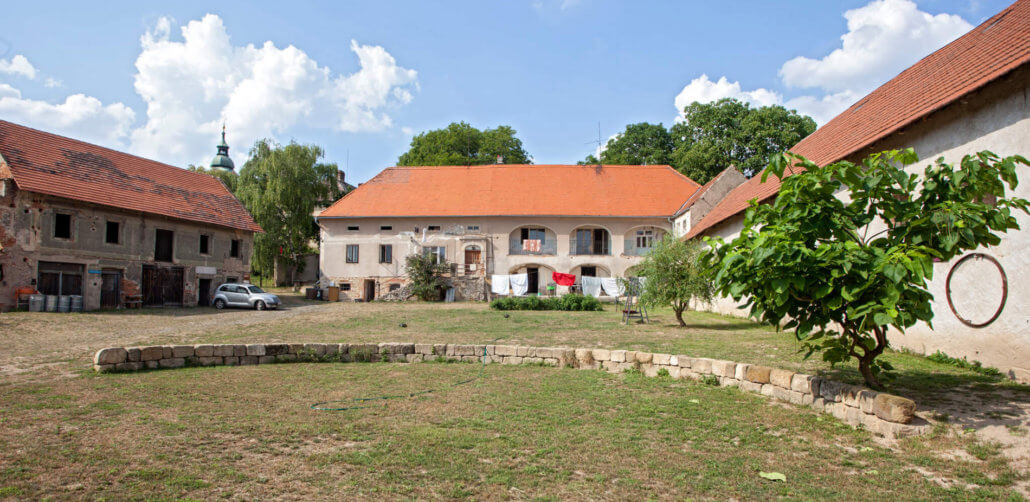
Bohemia FARMSTUDIO, Vysoká 26
Bohemia FARMSTUDIO is an independent art and research platform
dedicated to supporting contemporary art, interdisciplinary collaboration, and
long-term artistic processes developed in close relation to landscape, place,
and time. Its mission is to create conditions for focused artistic work,
knowledge exchange, and international collaboration outside major institutional
centers. The platform responds to the need for sustained, process-based artistic
practice by offering an environment that allows for concentration, continuity,
and deep engagement with both the working context and the surrounding landscape.
Bohemia FARMSTUDIO develops residency, workshop, and consultation programs that bring together artists, theorists, and practitioners interested in site-specific, process-oriented, and environmentally sensitive approaches. It organizes short-term and long-term artist residencies for local and international participants, providing space for artistic research and experimentation without immediate pressure to produce final outputs. Emphasis is placed on extended stays, long-term engagement, and direct, embodied experience of the site as an integral component of artistic practice.
A key aspect of the platform’s activity is the development of interdisciplinary and international collaboration. Bohemia FARMSTUDIO supports projects that connect visual arts, sound practices, performance, text-based work, and environmental and landscape-oriented approaches. Through international residencies, working meetings, and workshops, the platform fosters artistic mobility and long-term professional exchange, bringing together participants from different cultural, geographic, and generational backgrounds.
An important part of its program consists of practice-based workshops that have already been implemented and tested in an international context. These workshops focus on site-specific and landscape-based methodologies, bodily and perceptual approaches to space, and methods of process documentation using text, image, and sound. Particular attention is given to exploring the relationship between artistic practice and environmental thinking. International workshop residencies led by experienced artists and theorists combine fieldwork in the surrounding landscape with collective discussion and reflective sessions, emphasizing the exchange of methods, experiences, and working strategies among participants.
Bohemia FARMSTUDIO also provides professional consultations, mentoring, and individual working sessions, creating space for informal discussion and collective reflection on ongoing projects. These formats encourage critical thinking, self-reflection, and the articulation of artistic processes rather than solely their outcomes. Presentation and dissemination activities take the form of small-scale presentations, open studios, and work-in-progress formats, focusing on the visibility of research, experimentation, and process-based work. Outcomes are often preserved through archival and documentary materials, including texts, recordings, and visual documentation.
In the long term, Bohemia FARMSTUDIO aims to build a stable and sustainable model of independent cultural infrastructure rooted outside urban centers. Its activities are developed with strong attention to regional and landscape contexts and to the specific conditions of rural environments. Through continuous artistic research and international exchange, the platform explores connections between artistic practice and broader questions of time, memory, ecology, and human–environment relations, contributing to the diversity and depth of contemporary cultural production.
more:
BIOGRAPHIES
Milos Sejn works in the fields of visual art, performance, and the study of visual perception. Since the early 1960s, he has been photographing, drawing, collecting, and carefully recording his observations of nature during long wanderings through repeatedly traversed and gradually internalized landscapes. This work grows from sustained bodily engagement with landscape, understood not merely as a visual phenomenon but as a lived, For nearly twenty years, he worked as a professor of intermedia at the Academy of Fine Arts in Prague and held guest teaching positions at several European art academies. Artistic practice unfolds through long-term observation and direct bodily experience–through immediate, repeated acts born of encounters between body, place, and time. Moving between historically shaped, humanized landscapes and areas of intact nature, he attends to subtle shifts, temporal sedimentations, and nearly imperceptible exchanges between natural processes and human presence. His work is grounded in return.
Publications:
Being
Landscape,
Faces,
Kunst Raum Natur
Films:
Lampyris,
Because I Have To
Frank van de Ven
has 30 years of experience teaching dance, theatre and creative
movement in many Art Colleges, Universities and Dance Institutions around the
world. His main practice is Body Weather, a comprehensive approach to training
and performance that investigates the intersections of bodies and their
environments. Bodies are conceived not as fixed and separate entities but as
constantly changing - just like the weather. Weather is seen as a complex system
of forces and influences coursing through and beyond bodies and the world.
The
term and philosophical basis for Body Weather was founded in the early 1980's by
dancer Min Tanaka and the Maijuku Performance Company, with whom Frank worked in
Japan, from 1983-1991. Since 1995 he has been conducting the annual,
interdisciplinary Bohemiae Rosa Project with Milos Sejn, connecting body and
landscape with art, geology and architecture.
Practices and workshops:
Body Weather Amsterdam
Films (video and 16mm): Dancing Plasy Times 8, CI-VIT,
LOM
and NOUGHTS.
Podcast:
The Improvisors
Dictionary definitions
*site n., pl. -s [Latin situs "place, position", from sinere "to leave, place, lay"] 1. the actual or planned location 2 the place or scene of something (a camp site) / site vt., to place on a site or in position: locate
*body n., pl. -ies [OE, bodig, cask] 1. the whole physical substance of a man, animal or plant 2. the trunk of a man or animal 3. a corpse 4. [Colloq.] a person 5. a distinct mass [a body of water] 6. a distinct group of people or things 7. the main part 8. substance or consistency, as of liquid 9. richness of flavor
*landscape n., pl. -s [Dutsch landschap, from land + -schap "-ship"] 1. a picture of natural inland scenery 2. a portion of land that the eye can see in one glance
*wander vb., wan-dered, wan-der-ing [OE, wandrian] 1. to move about aimlessly or without a fixed course or goal: ramble 2a to deviate (as from a course): stray 2b to go astray morally: err 2c to lose normal mental contact (as delirium or madness)
*walk n., pl. -s [vb OE, wealkan "to roll, toss"] 1. a going on foot (go for a walk) 2. a place, path, or course for walking 3. distance to be walked 4a manner of living 4b social or economic status (various walks of life) 5a manner of walking 5b a gait of a four-footed animal in which there are always at least two feet on the ground
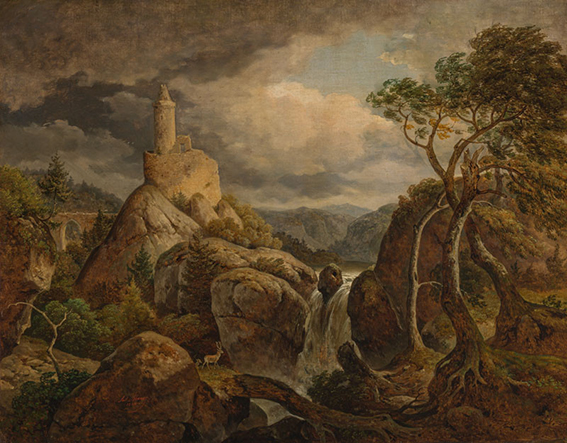
Antonín Mánes:
Kokořín Castle, 1839, National Gallery in Prague
Important part of the cultural history of the place.
P
roduction of Bohemiae Rosa Project: Katerina Bilejova